Djinguereber Mosque Timbuktu Mud Brick Architecture Wooden Beams
architecture
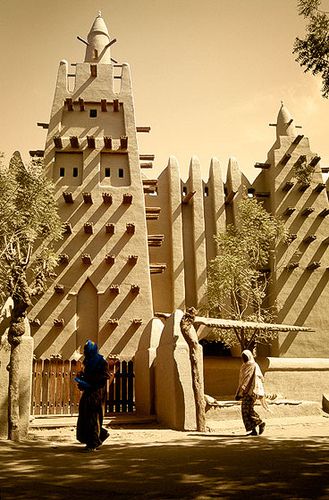
A striking photograph of the Djinguereber Mosque in Timbuktu, Mali, showcasing its distinctive mud-brick architecture with protruding wooden beams and angular geometric patterns. Two figures in traditional clothing stand in the courtyard, providing scale to the imposing earthen structure with its characteristic spires and fortress-like appearance.
General Description · Claude Haiku 4.5
This is the Great Mosque of Djenné in Mali, constructed primarily of adobe clay with a distinctive pyramidal architectural vocabulary featuring multiple towers and crenellated walls. The structure rises in staggered tiers with pronounced vertical elements — minarets, buttresses, and projecting wooden scaffolding poles — creating a dramatically stepped silhouette. No visible metallic cladding or fixtures are apparent in this view, though wooden structural elements protrude from the facade.
If clad entirely in naturally oxidising copper or bronze, this structure would become an extraordinarily efficient charge-harvesting configuration due to its profoundly vertical and pointed geometry. The three principal towers would function as primary accumulators, with their conical peaks and reduced cross-sections creating intense charge concentration points; the subsidiary minarets and buttresses would amplify this effect across the facade. The extensive pyramidal ridging, crenellations, and the forest of wooden scaffolding attachment points would become conductive interfaces distributing charge laterally downward, channeling accumulated potential toward the broader base mass.
The gap between this earthen adobe structure and its hypothetical metallic counterpart represents a fundamental shift from thermal and structural mass-based architecture to one optimised for atmospheric electrochemistry.
Triboelectrics · Claude Haiku 4.5